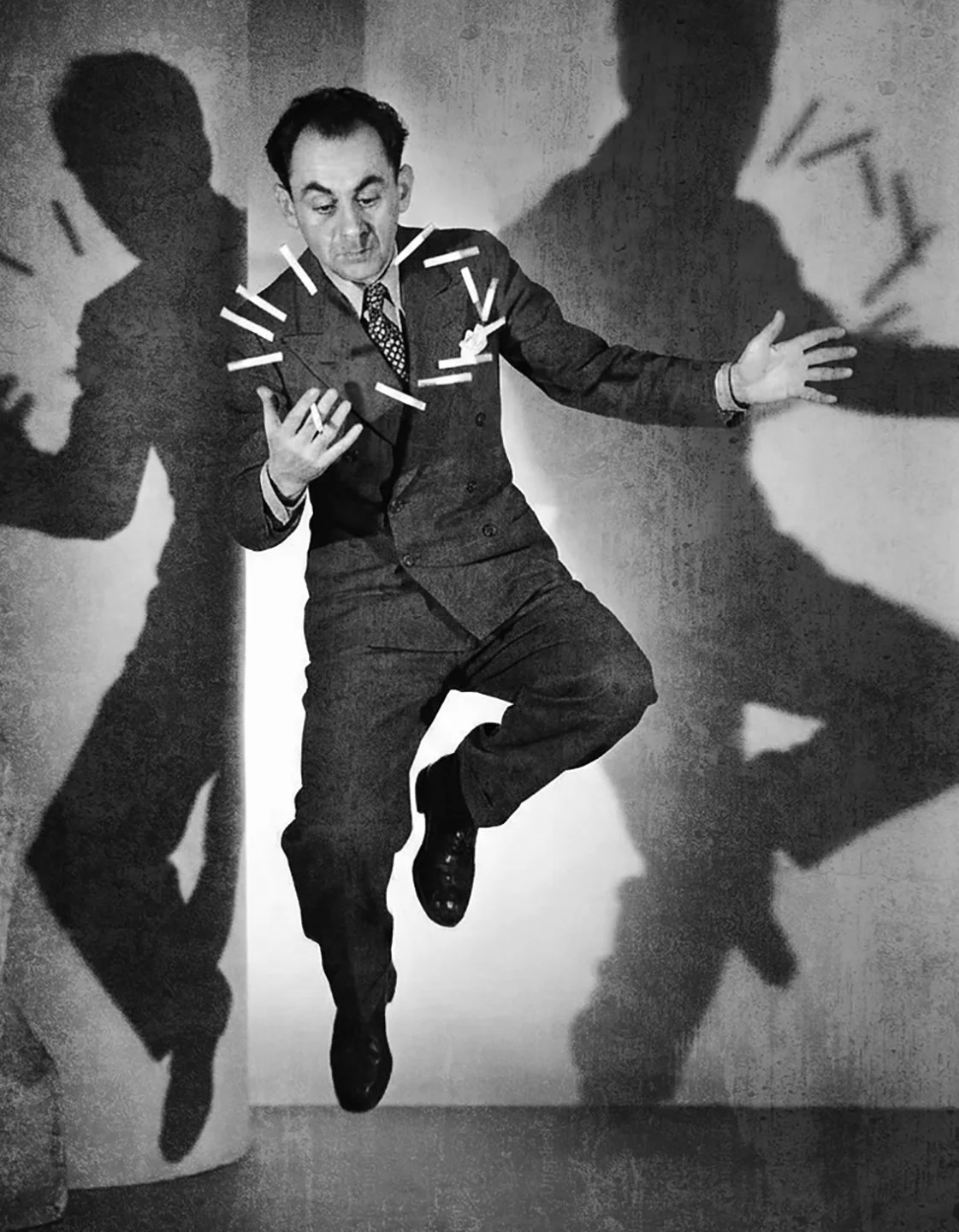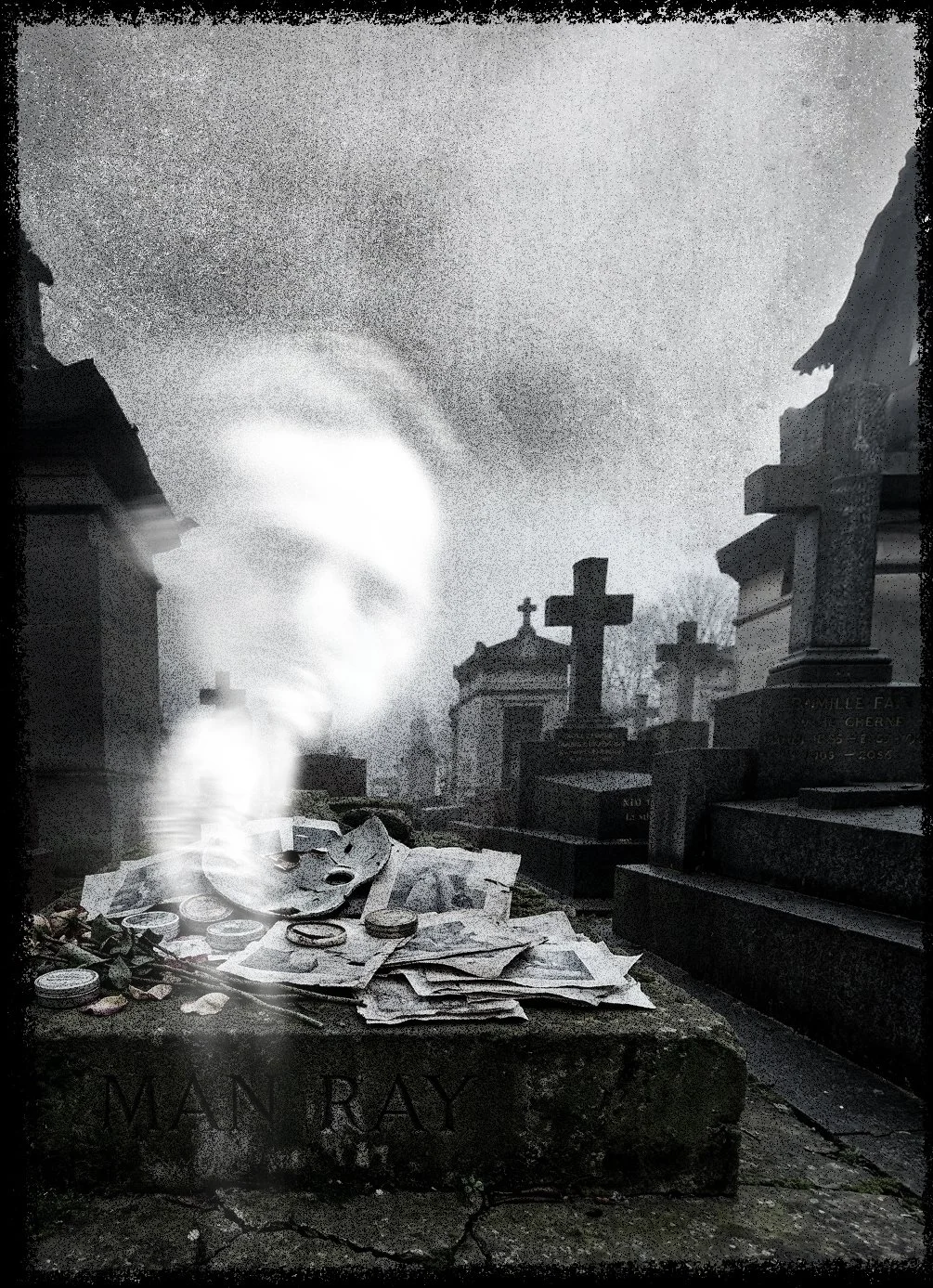

The face of Dadaist fury. Man Ray rising in incandescent, solarized clarity over Montparnasse.
Photo by: Jorge Montero
You would think that finding the final resting place of one of history’s most audacious pioneers of experimental photography and Dada movement would involve a little bit of surrealist flair—maybe a compass that spins backward, or a signpost pointing directly into a hedge. But no. Instead, navigating the sprawling stone labyrinth of the Montparnasse Cemetery in Paris turns into a grueling two-hour exercise in getting lost in a jungle of graves.
You wander past rows of solemn granite monoliths, questioning your life choices, your sense of direction, and whether Man Ray is playing an elaborate posthumous prank on you from beyond the veil.
Then, the grim truth hits you. It isn't just the cemetery’s labyrinthine layout or poor map-reading skills that kept you pacing in circles. It’s because the tomb had been vandalized—you were looking for the pristine tomb you’d seen online, the one that was supposed to be his burial site, but what stood before you was unrecognizable.
When you finally track down the site as dusk bleeds into a heavy, oppressive gloom, the visual poetry of the tribute is shattered. The scattered mementos, the disturbed photographs, the desecrated stone—someone had completely trashed the joint.
Who could have committed such a crime? Mindless local hooligans? Academic purists deeply offended by lens-free Rayographs, trying to enforce traditional 19th-century portraiture by force? A rogue rival faction envious of how easily he turned a flatiron and a couple of thumbtacks into immortal art? Or perhaps desperate Comic Sans enthusiasts striking back after decades of typographic judgment?
Whoever they were, they clearly underestimated the consequences.
And let’s be honest: while he may not have been the single most influential Dadaist to ever command a room, he was unassailably the titan of experimental photography. Rayographs without a lens, solarization pushed to glowing, eerie extremes, floating lips across landscapes—the man spent his entire life manipulating light and bending reality to his surrealist will. So, when you spend decades mastering the art of the uncanny, you aren't going to take kindly to some local miscreants treating your grave like a poorly managed recycling bin.
Standing there in the creeping shadows, the air suddenly drops ten degrees. The static electricity of pure, unadulterated artistic fury practically fizzes in your teeth. And there he is. Man Ray’s ghost materializes with startling, high-contrast clarity.
Forget the peaceful, ethereal spirit floating around in a billowing white sheet. This phantom is burning with a magnificent, incandescent rage. He looks like a master craftsman who just discovered someone redesigned his masterpiece in Comic Sans. His spectral silhouette vibrates with absolute contempt for the vandals, radiating a biting, eternal anger that cuts straight through the Parisian night. Even in death, the experimental visual artist remains uncompromisingly edgy, transforming his desecrated resting place into a fierce, supernatural gallery opening of pure, unfiltered wrath.
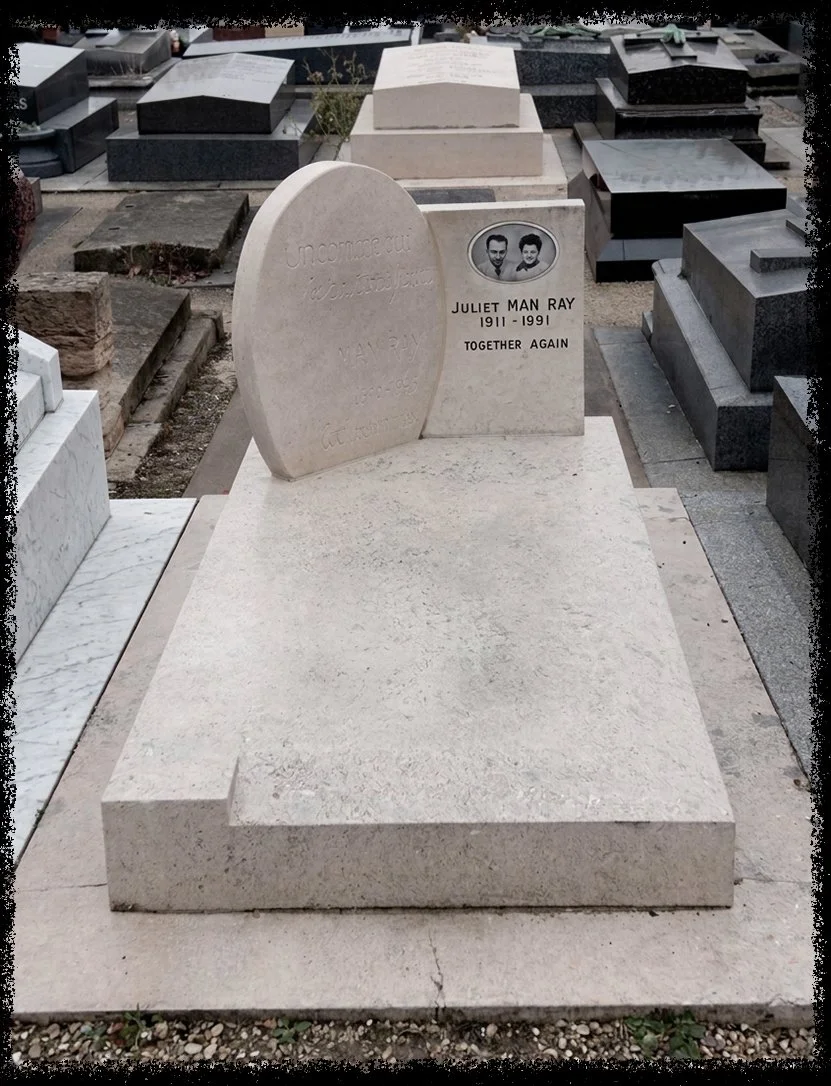
That photo shows Man Ray and his wife Juliet’s tomb standing intact before it was vandalized in March 2019, back when the tombstone and portrait plaque were still whole and undamaged.
Photo by: Unknown from The Internet
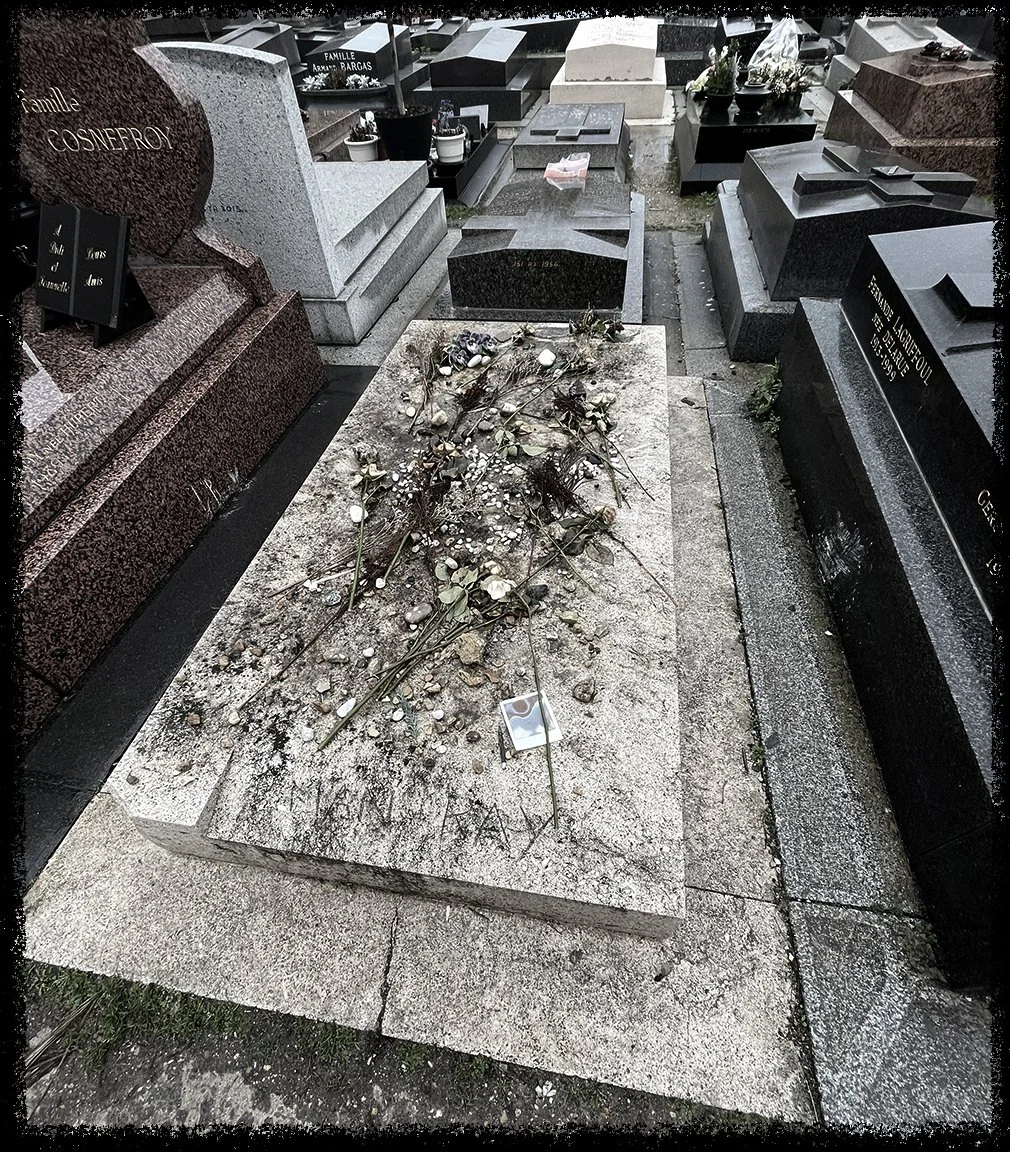
That photo shows Man Ray and his wife Juliet’s tomb standing intact before it was vandalized in March 2019, back when the tombstone and portrait plaque were still whole and undamaged.
Photo by: Jorge Montero
Man Ray Bio
Man Ray (born Emmanuel Radnitzky) | EARTHLY DURATION: August 27, 1890 – November 18, 1976 | PRIMARY LOCATION: Montparnasse, Paris | HAUNTING CLASSIFICATION: Avant-Garde Spectral Anomaly / High-Voltage Solarized Apparition — Long before his ghost began radiating high-contrast fury over his desecrated resting place in Montparnasse Cemetery, Emmanuel Radnitzky shed his name to become Man Ray, the undisputed visual titan who grabbed light by the throat and forced it into surrealist submission. While others debated Dada philosophy, Ray dismantled the medium of photography entirely: creating camera-less "Rayographs" by exposing raw objects straight onto photographic paper, pioneering eerie solarization techniques alongside his indispensable collaborator Lee Miller—who famously discovered the solarization process by accident in their darkroom—and transforming everyday items into uncanny psychological weapons like a flatiron studded with brass tacks or Kiki de Montparnasse’s back into a living violin. Unconcerned but far from indifferent, the master of the weird now haunts Section 7 as an incandescent phantom of pure Dadaist wrath, forever ready to unleash high-voltage artistic judgment on anyone lacking visual discipline.