Reported by
Professor Louis Baker
We spent a lingering, fog-drenched evening with American Ghost Tours in Savannah, weaving through the whispers of River Street and haunting the unique squares where the veil between worlds seems thinnest. Amidst the local artists and our own frantic snapping of photos—hoping to catch more than just shadows—we felt the city’s pulse.
Our 8 p.m. rendezvous with American Tours was, for me, a baptism by fire. Having never dared to join a ghost tour before, I confess I was thoroughly—and unsettlingly—impressed. Our guide, Melissa, navigated the town’s most treacherous spectral hotspots with unnerving grace. I’m happy to report that she was still gloriously sane when we bid her farewell, though I suspect she left a piece of her soul behind in the shadows.
Consider the ground beneath our feet: when Savannah was first etched into the map in 1733, these very lots were consecrated as a burying ground. William Cox, a surgeon who arrived on the Ann, was the first of the colonists to succumb, laid to rest here with all the appropriate—and perhaps desperate—ceremonies. The earth remained hungry until roughly 1750, when the dead were finally moved to the larger expanse we now know as Colonial Park. Yet, one has to wonder... did they all actually leave?
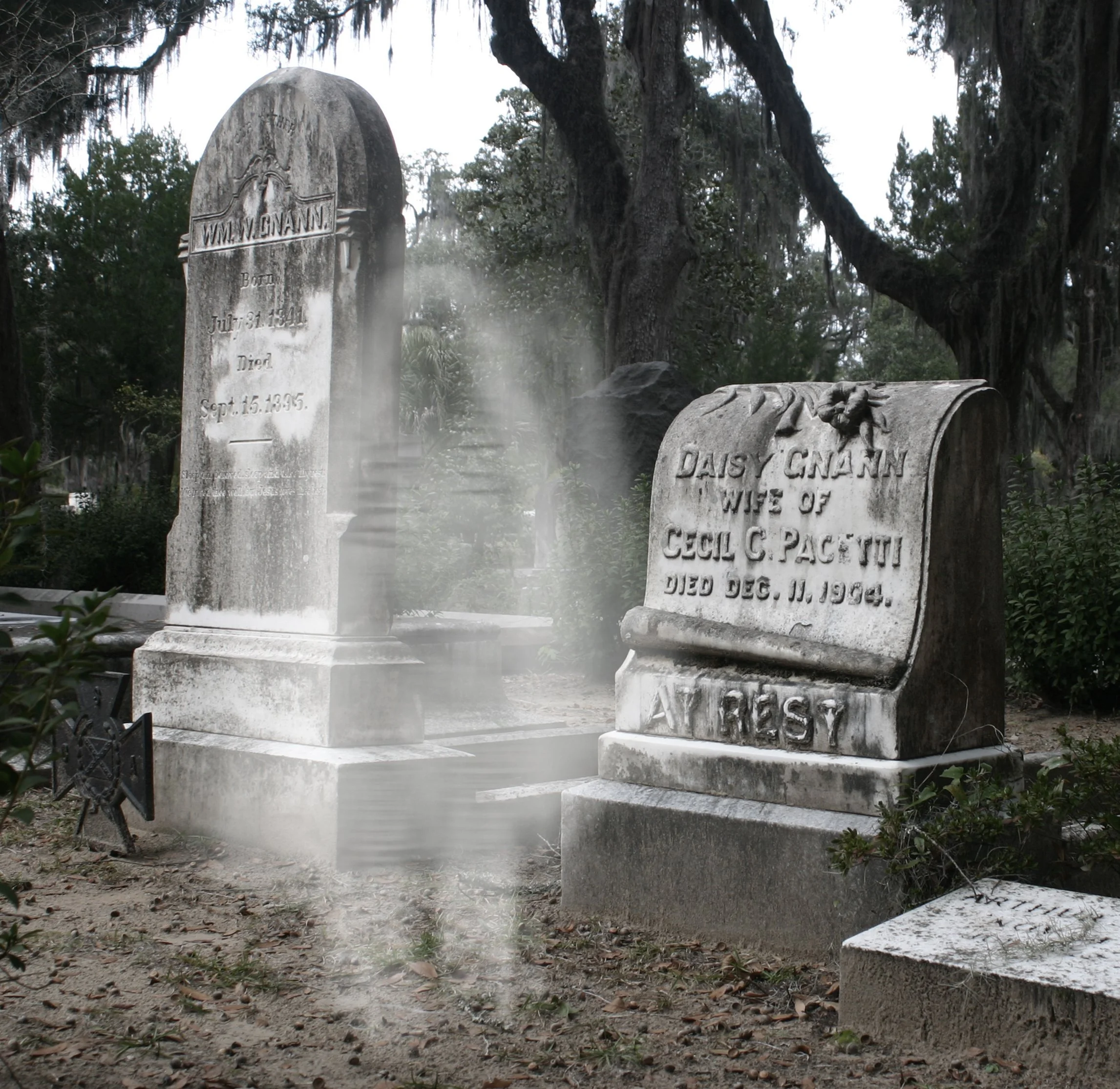
The Ghost of The Daisy Nowlen Gnann & Cecil C. Pacetti Grave
Captured at Savannah’s Bonaventure Cemetery, a spectral form rises between the monuments—a whisper of history refusing to be tethered to stone. Some believe this ethereal figure is the manifestation of lingering grief, a silent observer eternally watching over the final resting place of Daisy Nowlen Gnann.
Based on genealogical records, here are the details regarding the individuals visible on the markers:
Daisy Nowlen Gnann: She was born on July 20, 1873, and passed away on December 11, 1904. She was 31 years old at the time of her death.
Cecil C. Pacetti: Daisy’s husband, Cecil C. Pacetti, was born on November 24, 1874. They were married on January 19, 1904, just months before her untimely passing.
Wm. W. Gnann: The larger monument to the left of Daisy’s marker belongs to Wm. W. Gnann, who was born on July 31, 1811, and died on September 15, 1885.
The Gnann and Pacetti families are prominent names in Georgia history, particularly associated with the Georgia Salzburgers. Savannah is home to several historic cemeteries, such as Bonaventure, Laurel Grove, and Colonial Park, which are well-known for their elaborate Victorian-era grave markers, live oaks, and Spanish moss. The Georgia Salzburgers were a group of devout, German-speaking Protestant refugees who fled religious persecution in the Catholic Archbishopric of Salzburg (modern-day Austria) to establish a new life in the Georgia colony.
Origins and Migration
The Edict of Expulsion: In 1731, Count Leopold von Firmian, the Prince-Archbishop of Salzburg, issued an edict forcing thousands of Protestants to either recant their faith or abandon their homes.
Journey to Georgia: Seeking refuge, about 300 Salzburgers accepted an invitation from King George II of Great Britain to settle in Georgia. Led by Lutheran pastors Johann Martin Boltzius and Israel Gronau, the first transport arrived in Savannah on March 12, 1734.
Settlement and Challenges
Ebenezer: The settlers founded a town named Ebenezer—meaning "stone of help"—about 25 miles upriver from Savannah.
Early Hardships: The original site was swampy and infertile, leading to poor water quality, disease (such as dysentery), and high mortality rates.
New Ebenezer: In 1736, the group relocated to a higher bluff on the Savannah River, which they called "New Ebenezer". This site proved more successful, allowing them to establish legitimate farmsteads and develop a thriving economy.
Prosperity and Legacy
Economic Contributions: Known for their industriousness, the Salzburgers became successful in cattle breeding, agriculture, lumber production, and silk reeling. They built some of Georgia’s first water-driven grist and saw mills.
Cultural and Religious Life: Their community was centered around the Jerusalem Evangelical Lutheran Church, which remains a standing remnant of their colonial presence. They were known for their piety, modesty, and strong sense of independence, which at times isolated them from other colonial Georgians.
Decline: The community thrived for several decades, growing to over 1,200 people by the mid-18th century. However, their distinct traditions began to fade following the death of Pastor Boltzius in 1765 and the subsequent destruction of Ebenezer during the American Revolutionary War.
Today, the Georgia Salzburger Society—founded in 1925—works to preserve the history and heritage of these early settlers.