


Some spirits leave quietly, exiting the stage without so much as a rustle of leaves. Others prefer to linger with an enduring grace, leaving behind subtle signatures that defy simple explanation.
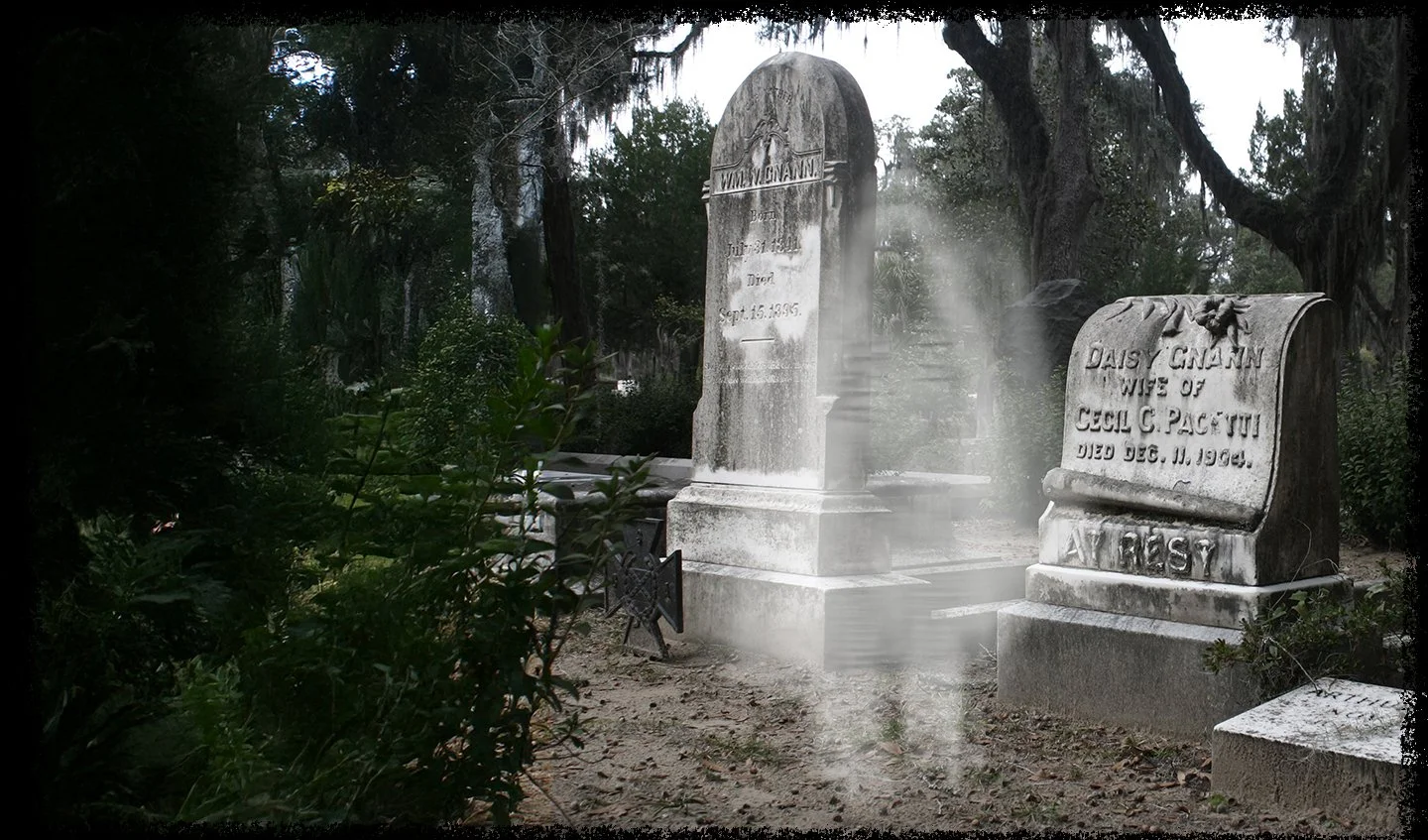
Deep within the shadowed expanse of Savannah’s Bonaventure Cemetery—where centuries of memory hang suspended beneath live oaks wrapped in heavy gray moss—a delicate, luminous ribbon of light curves gently upward between the weathered markers. It glides past the granite like an ethereal thread of history, soft and radiant against the dark, iron-stained stone.
Positioned at the edge of the Gnann family plot, this radiant form hovers beside the monument honoring Daisy Nowlen Gnann. A pragmatist will inevitably speak of atmospheric humidity, optics, or a stray beam of coastal afternoon light refracting inside the glass of a camera lens. Yet, there is an undeniable reverence in the way this light settles over the earth—a posture so deliberate that it demands a pause. Is it an anomaly of exposure, a quiet sentry keeping watch, or the visual footprint of a story that refuses to be buried?
To understand the weight of this quiet corner of Bonaventure, one must read the stone as a historical ledger.
Daisy was just 31 years old when she passed away in December 1904. Only eleven months earlier, in January of that same year, she had married Cecil C. Pacetti, uniting two lineages rooted deeply in Georgia’s early narrative. Standing beside her smaller marker is the imposing monument of William W. Gnann (1811–1885), an antebellum patriarch whose family name carries the full historical weight of the Georgia Salzburgers.
The story carved into these stones stretches back far beyond the iron gates of Bonaventure, reaching into the religious strife of 18th-century Europe. In 1731, Prince-Archbishop Count Leopold von Firmian issued the Edict of Expulsion, forcing thousands of German-speaking Protestant Lutherans to abandon their ancestral homes in the Archbishopric of Salzburg or renounce their faith. Driven out into the cold, around 300 of these refugees accepted an invitation from King George II of Great Britain to seek freedom in the newly formed colony of Georgia.
Led by pastors Johann Martin Boltzius and Israel Gronau, the first Salzburger transport stepped ashore in Savannah on March 12, 1734. Pushing inland, they established a settlement named Ebenezer—the biblical "stone of help." The original site was a punishing swamp, plagued by poor water and dysentery. Undeterred by staggering loss, the survivors relocated in 1736 to a high bluff on the Savannah River, establishing New Ebenezer.
At New Ebenezer, the Salzburgers built a flourishing, industrious community. They constructed Georgia’s first water-driven grist mills and sawmills, engineered early silk-reeling operations, and established thrive-or-die agricultural practices centered around their spiritual sanctuary, Jerusalem Evangelical Lutheran Church. Though the community was largely shattered during the American Revolutionary War, their descendants remained tied to the soil, shaping the development of Effingham and Chatham counties for centuries.
When you walk the winding, shell-paved paths of Bonaventure today, past the Victorian funerary art and weeping angels, you are walking through the physical library of this migration. The names carved into the marble—Gnann, Pacetti, and their contemporaries—are the living titles of Georgia’s founding chapters.
Whether that soft streak of light captured over Daisy’s plot is a quirk of the lens or a gentle nod from the past, it serves as a striking reminder: stone may mark a lifespan, but the human story leaves an echo far too persistent for gravity to hold down.
Based on genealogical records, here are the details regarding the individuals visible on the markers:
Daisy Nowlen Gnann: She was born on July 20, 1873, and passed away on December 11, 1904. She was 31 years old at the time of her death.
Cecil C. Pacetti: Daisy’s husband, Cecil C. Pacetti, was born on November 24, 1874. They were married on January 19, 1904, just months before her untimely passing.
Wm. W. Gnann: The larger monument to the left of Daisy’s marker belongs to Wm. W. Gnann, who was born on July 31, 1811, and died on September 15, 1885.
The Gnann and Pacetti families are prominent names in Georgia history, particularly associated with the Georgia Salzburgers. Savannah is home to several historic cemeteries, such as Bonaventure, Laurel Grove, and Colonial Park, which are well-known for their elaborate Victorian-era grave markers, live oaks, and Spanish moss. The Georgia Salzburgers were a group of devout, German-speaking Protestant refugees who fled religious persecution in the Catholic Archbishopric of Salzburg (modern-day Austria) to establish a new life in the Georgia colony.
Origins and Migration
The Edict of Expulsion: In 1731, Count Leopold von Firmian, the Prince-Archbishop of Salzburg, issued an edict forcing thousands of Protestants to either recant their faith or abandon their homes.
Journey to Georgia: Seeking refuge, about 300 Salzburgers accepted an invitation from King George II of Great Britain to settle in Georgia. Led by Lutheran pastors Johann Martin Boltzius and Israel Gronau, the first transport arrived in Savannah on March 12, 1734.
Settlement and Challenges
Ebenezer: The settlers founded a town named Ebenezer—meaning "stone of help"—about 25 miles upriver from Savannah.
Early Hardships: The original site was swampy and infertile, leading to poor water quality, disease (such as dysentery), and high mortality rates.
New Ebenezer: In 1736, the group relocated to a higher bluff on the Savannah River, which they called "New Ebenezer". This site proved more successful, allowing them to establish legitimate farmsteads and develop a thriving economy.
Prosperity and Legacy
Economic Contributions: Known for their industriousness, the Salzburgers became successful in cattle breeding, agriculture, lumber production, and silk reeling. They built some of Georgia’s first water-driven grist and saw mills.
Cultural and Religious Life: Their community was centered around the Jerusalem Evangelical Lutheran Church, which remains a standing remnant of their colonial presence. They were known for their piety, modesty, and strong sense of independence, which at times isolated them from other colonial Georgians.
Decline: The community thrived for several decades, growing to over 1,200 people by the mid-18th century. However, their distinct traditions began to fade following the death of Pastor Boltzius in 1765 and the subsequent destruction of Ebenezer during the American Revolutionary War.
Today, the Georgia Salzburger Society—founded in 1925—works to preserve the history and heritage of these early settlers.