


The Lore:
Born on the Asphalt
Long before he was immortalized as a high-voltage stencil burned onto the fabric of reality, the Velo Specter was the undisputed, mythical apex predator of midnight alleycat races—a brakeless courier who treated rush-hour gridlock, red lights, and basic human biology as purely optional suggestions. He ruled the rain-slicked concrete canyons of the metropolis astride a custom steel track bike, hauling impossible payloads and radiating a cold, silent refusal to ever touch a brake lever.
Local folklore insists he didn’t even die in a conventional crash. The truth is far less tragic and infinitely cooler: he attacked a razor-sharp hairpin turn over slick cobblestones at terminal velocity, outran his own shadow, and phase-shifted straight through the space-time continuum out of sheer, stubborn momentum.
Today, the Velo Specter materializes wherever ambient excuses get too loud and human drama reaches an unacceptable decibel. He is the unyielding patron saint of gritted teeth, lactic acid, 3:00 AM deadlines, and zero-excuse execution. If you’re looking for a spirit guide to validate your feelings, keep walking. If you need a phantom to stare you down until you finish the job, welcome home.
The Archival Origins: Blood, Cobbles & Steel
To understand the ghost, you have to trace the tire tracks back to the treacherous limestone cliffs of Rochecorbon—a notorious, razor-sharp riverbank bend along the Levée de la Loire just outside Tours, France.
The 1788 Royal Dispatch Incident: During the brutal, icy pre-Revolutionary winter of November 1788, the crown relied on chevaucheurs—ruthless, heavily booted dispatch riders who thundered along the Loire embankments to carry royal decrees between Paris and Tours. The most unhinged among them was Jean-Luc "Le Volant" (The Flying Courier), a man who treated weather warnings as personal insults. On a pitch-black, storm-lashed night, carrying urgent dispatches into Tours, Jean-Luc hit the lethal Rochecorbon hairpin. Where any sane rider would haul back on the reins, Jean-Luc buried his iron spurs deeper to outrun a surging river flood. His mount lost traction on the wet stone, launching horse, rider, and leather satchel off the limestone cliff into the churning black abyss of the Loire. No body ever washed ashore—only a lingering trail of scorched iron sparks etched into the curb.
The 1896 Velocity Rebirth: For over a century, the Rochecorbon bend remained a whispered superstition among locals. Then came May 17, 1896—the inaugural running of the Paris–Tours bicycle race, one of the oldest and most punishing road classics in cycling history. As exhausted pioneers hammered their primitive, fixed-gear velocipedes down the river road toward the finish line, riders trailing the peloton witnessed a chilling anomaly. Rounding the Rochecorbon curve, a gaunt, skeletal silhouette astride a matte-black, brakeless iron track frame materialized out of the mist beside them. Refusing to feather his pedals for the turn, the phantom leaned impossibly low, locked his hollow eye sockets on the horizon, and accelerated into the apex—spraying a blistering wake of electric-pink ectoplasmic static across the wet asphalt before evaporating into the night.
The Story Behind the Art
The visual architecture of this piece deliberately collides two antagonistic worlds: a brooding, 19th-century daguerreotype aesthetic representing the heavy, suffocating weight of the daily grind, violently interrupted by a searing, neon-pink stencil application. That glowing spray splatter isn't just street-art bravado—it is a literal rupture in the dark frame. It captures the exact millisecond you silence the mental static, drop your shoulders, grip the bars, and hammer through the wall.
Spectral Capabilities & Room Dynamics
Anti-Drama Forcefield: Emits a relentless, high-frequency aura engineered to instantly vaporize minor personal complaints, toxic group-chat spirals, and self-inflicted angst within a twenty-foot radius.
Aggressive Chromatic Contrast: Built on an ultra-deep obsidian underbase slashed by radioactive neon-pink overspray that detonates off the wall like a fresh, illegal midnight wheatpaste poster.
Optimal Habitat: Mount him directly above your bike rack, home gym, studio desk, or anywhere you sit when the urge to quit early starts whispering in your ear. One glance at that stoic, skeletal jawline delivers the exact same non-negotiable directive every single time: Grip the bars. Hit the stride. Drop the drama.
A Tale of the Velo Specter:
The Apex Line
Leo kept his bedroom window cracked open year-round, not for the fresh air, but for the soundtrack. Two blocks down, the old railway viaduct sliced through the neighborhood, and underneath it lay The Dip—a blind, razor-sharp asphalt S-curve that every kid on a bike treated as a rite of passage.
At fourteen, Leo’s life was measured in gear ratios and tire pressure. But tonight, the air in his room felt heavy, smelling sharply of ozone and wet pavement, even though it hadn't rained in weeks. On the wall above his bike rack, the high-contrast print of the Velo Specter seemed... different. The searing neon-pink spray splatter cutting across the dark daguerreotype background wasn’t just catching the lamplight from the street; it was pulsing, casting a faint, electric-magenta glow across his ceiling.
Leo checked his phone. 3:14 AM.
His legs were dead. Earlier that evening, he’d completely blown his chain on the final climb of the city circuit, walked his bike the last mile home in utter humiliation, and thrown his helmet across the garage. He had sat at his desk for hours, staring at a blank training log, writing out a long, pathetic paragraph of excuses about his gear, his fatigue, and the headwind.
Suddenly, a dry, metallic tick-tick-tick echoed from the alley below—the unmistakable sound of a high-engagement track hub coasting to a halt on fresh asphalt.
Leo crept to the window and looked down.
The streetlights had flickered out, plunging the block into a deep, obsidian shadow. Standing right at the edge of The Dip was a towering, gaunt silhouette straddling a matte-black fixed-gear bike. The frame had no brakes, no cables, and no reflective tape—just raw, industrial steel that seemed to absorb the ambient light. As the rider turned his head upward, Leo felt his breath catch in his throat. Beneath the shadow of a peaked courier cap, the rider’s face was a stripped-down skull, its jaw locked in a relentless, silent grin, and its empty sockets burning with a faint, radioactive pink static.
It wasn't a hallucination. The air in Leo’s room dropped ten degrees, his skin instantly prickling with goosebumps as the Anti-Drama Forcefield rolled off the street like a physical wave, vaporizing every excuse he had muttered that night.
The Velo Specter didn’t speak. He simply raised one leather-gloved hand, pointed two fingers down toward the dark, sweeping curves of The Dip, and tapped the side of his unbraked top tube twice. Clack-clack.
A primal surge of terror and adrenaline hit Leo all at once. Without thinking, he grabbed his helmet, vaulted over his bed, unlocked the side door, and dragged his track bike out onto the pavement.
When he reached the corner, the alley was empty. But the asphalt beneath his tires was smoking faintly, glistening with a thin, iridescent layer of electric-pink residue that hadn't been there a moment before.
Leo’s heart hammered against his ribs. Every instinct screamed at him to turn back, to go back to his warm room, to accept that he was too tired to ride. But the phantom’s hollow gaze felt burned into the back of his skull.
He clipped into his pedals.
As he dropped into The Dip, the world dissolved around him. The cold night air screamed past his ears, turning into a high-frequency hum. The streetlamps blurred into a continuous streak of neon. Normally, his brakes would be clamped hard right now to fight the speed, but tonight, his hands hovered over the bars, totally unmoving.
Right at the apex of the blind curve—where the shadows pooled the thickest—a sudden gust of wind caught him, carrying the sharp scent of scorched iron sparks and ancient river mud from the Loire. Out of the corner of his eye, leaning impossibly low into the turn just inches from his handlebars, was the skeletal courier, matching his cadence stroke for stroke, leaving a glowing wake of pink static across the wet road.
Drop the drama, the silence hissed in his mind. Grip the bars.
Leo didn't flinch. He buried his weight into the drops, dropped his shoulder, and drove his legs down with a ferocious, burning fury, carving through the absolute center of the turn at a speed he had never dared before.
By the time he rocketed out of the curve and hammered up the straightaway, his lungs burned, his legs were on fire, and the phantom was gone.
Back in his room, panting and drenched in sweat, Leo stared at his desk. The notebook where he had written his long list of excuses was still there. He picked up a pen, crossed the whole page out with a single, jagged stroke, and wrote three words:
Zero excuses left.
Above him, frozen in ink and neon, the Velo Specter stared straight ahead into the dark, silent and satisfied.
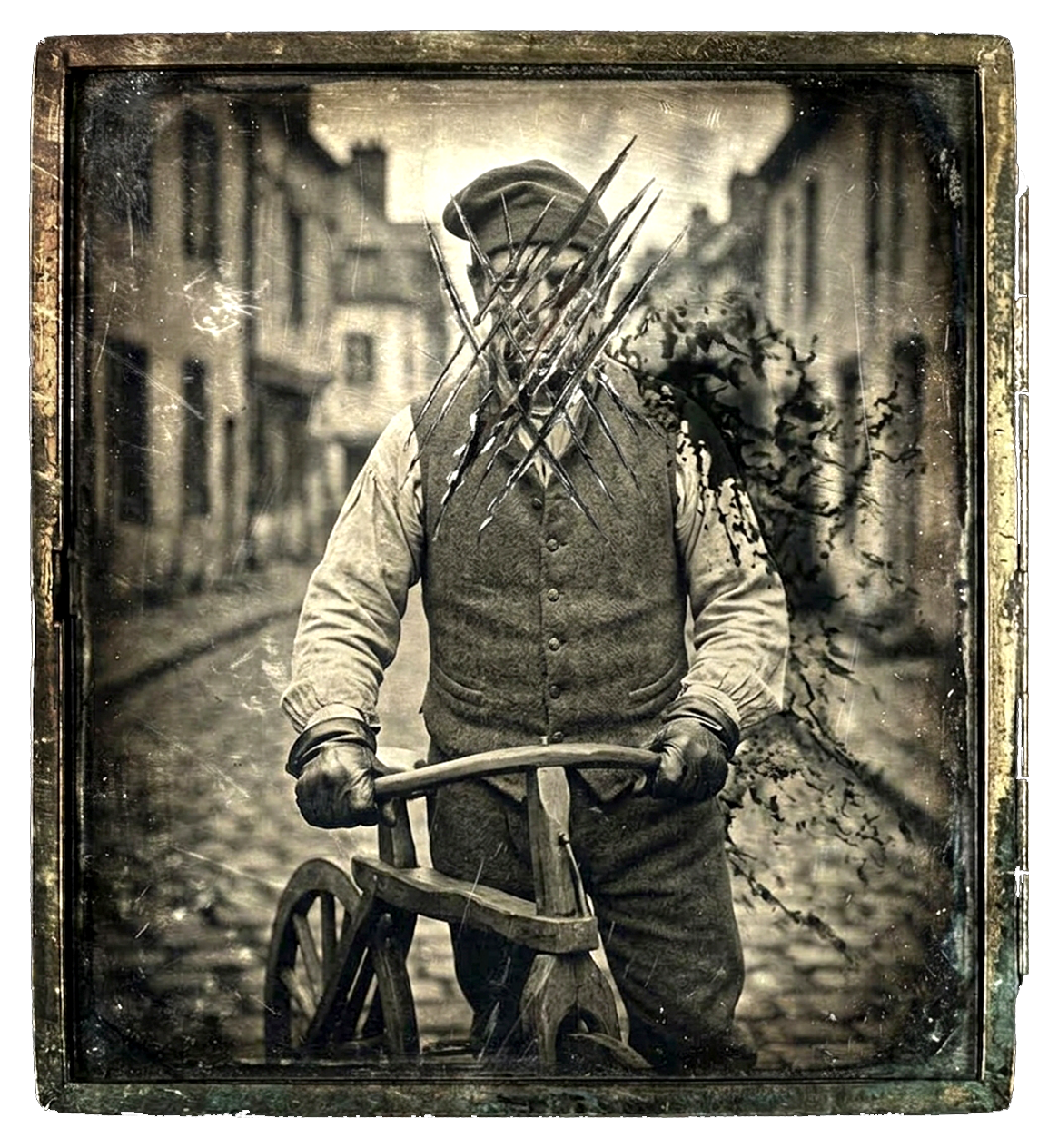
Before the Tour, before the peloton, there was Jean-Luc "Le Volant," an urban legend of 1790 who commanded the cobblestones of Tours on his wooden célérifère. A rider of zero brakes and unmatched speed, he took the fatal curve at Rochecorbon as a challenge, not a risk. What remains is this daguerreotype of the Velo Specter: face violently fractured by iron splinters, shadowed by an unyielding phantom force, a reminder born on the Loire bank that some riders are simply meant to run straight into immortality. Pedal on. Drop the drama.