


Entity Profile:
The Tokoloshe
Entity Classification: Southern African Water Sprite, Knee-High Tactical Guardian & Uncompromising Domestic Auditor
Origin: The Deep River Currents, Shaded Pools, and Silent Marshlands of Zulu and Xhosa Oral Tradition
Adoption Status: Available for Immediate Sanctuary (Provided you own enough cinder blocks to command his respect)
The Legend & Lore:
Purpose-Built Power in a Compact Frame
Before modern culture reduced folklore to glowing screens, cinematic jump-scares, and generic ghosts clanking invisible chains down generic hallways, traditional Southern African lore engineered something infinitely more cunning: The Tokoloshe.
Born from the dark, swirling currents of sacred rivers and deep marshlands, the Tokoloshe is not some drifting, aimless phantom of the ether. It is a purpose-built spirit of absolute focus. For centuries within Zulu and Xhosa traditions, these knee-high powerhouses were summoned through rigorous rites by keepers of ancient wisdom (Abathakathi) to enforce strict boundaries, settle old accounts, and guard sacred thresholds.
When invited into a modern sanctuary with clear intentions and mutual respect, that ancient, uncompromising drive translates into the ultimate line of spiritual defense. The Tokoloshe proves a foundational Ghostpedia truth: true power in the unseen world has nothing to do with towering size or theatrical pyrotechnics. It is entirely about density, cunning, and an absolute refusal to be ignored.
Unbeatable Perks of Bringing
The Tokoloshe Into Your Sanctuary
Zero Ghostly Theatrics, 100% Spatial Efficiency: Forget exhausting poltergeists that throw fine china or leave mysterious cold spots in the middle of your living room. The Tokoloshe operates with the minimalist, tactical discipline of a master strategist. Standing roughly knee-high, he doesn't need to dominate the cubic footage of your room to command the entire space.
Certified Architectural Perimeter Defense: If you have ever toured traditional homesteads across Southern Africa and wondered why bedframes are perched high on cinder blocks, red clay bricks, or hand-carved wooden risers, you were looking at practical, brilliant folklore in action. Because the Tokoloshe operates under strict physical spatial constraints, elevating your resting space just 10 to 12 inches off the floor places your sanctuary entirely out of his horizontal line of sight. It is history's greatest masterclass in turning home furnishing into spirit-proofing!
The Ultimate Anti-Toxicity Filter: The Tokoloshe thrives in environments driven by clear purpose and sharp focus. He acts as an organic, highly sensitive psychic air filter against passive-aggressive energy, sluggish routines, and draining, uninvited guests—making them feel so subtly and profoundly uncomfortable that they invent an early exit strategy within twenty minutes of arrival.
Unmatched Conversational Presence: Invite friends, colleagues, or curious guests into a room guarded by the Tokoloshe, and watch the room's dynamic shift. Prepare for lowered voices, sharp observations, and the inevitable, reverent question: "Where on earth did you uncover this?"
Real Reviews from Sanctuary Hosts!
"The ultimate houseguest filter."
"Ever since I brought the Tokoloshe record into my study, my focus has doubled and my chronic distractions have vanished. I raised my bed on heavy clay bricks just to respect the protocol, and honestly, the peace of mind alone is worth ten times the investment."
— M. V., Collector & Historian
"No regrets, just elevate."
"My cat used to stare blankly at the empty hallway corner every night. Now she just sits by the bookshelf where his portrait rests and nods respectfully toward the corner. We keep a polished brass bowl of fresh water nearby and honor the boundary lines. 10/10 companion."
— E. R., Dark Academia Curator
"Small footprint, massive gravity."
"You don't realize how much mental clutter you tolerate until you bring an entity into your home that has zero patience for half-measures. He stands quietly in his corner, reminding you to keep your standards high and your mind sharp."
— D. S., Architect
Field Notes:
The Audit of the River-Bank
When the temperature in your room drops by a precise, unnoticeable degree, and the faint, unmistakable aroma of crushed river reeds, damp earth, and clean running water overtakes the air, do not bother looking out the window.
He is already making his nightly rounds.
The Tokoloshe does not materialize to deliver melodramatic prophecies or rattle household hardware. Born of flowing currents and deep waters, he possesses the cold, unsentimental precision of a current carving through stone. To a cynical or distracted mind, your room will appear completely empty. But if your domestic animals suddenly freeze, their ears swiveling to track an invisible presence moving gracefully across the baseboards at midnight, do not panic—he is simply auditing your perimeter.
One small, clever hand taps lightly against the floorboards—a dry, rhythmic tick that echoes like a pebble hitting smooth river slate—reminding you in absolute silence that your time, your focus, and your space belong entirely to you.
And when he finally slips back into the shadows, leaving behind the clean, crisp scent of a mountain stream, you are left with one undeniable mandate: keep your intentions clear, elevate your standards, and never walk through the dark unanchored again.
A tale on the Tokoloshe:
The High-Water Mark of Pretoria
The piri-piri chicken had been a tactical error, but the quart of Castle Lager at three in the morning was an outright architectural collapse.
Rodrigo Da Silva, whose passport listed him as a landscape consultant from Florianópolis but whose mirror currently informed him he was a moderately damp turnip, adjusted his linen shirt collar with fingers that felt like peeled sausages. The gravel road leading back from the Hatfield district pub didn’t so much run toward his rented cottage as it tilted upward at an aggressive, slanderous angle.
Pretoria at four o’clock on a Tuesday is not a city; it is a dark, folded accordion of jacaranda trees, corrugated iron roofs, and shadows that smell intensely of eucalyptus and damp subtropical leaf-mold.
"Tranquilo," Rodrigo muttered to an empty telephone pole that seemed to be listing twelve degrees to port. "Just follow the blue gate. Three turns past the jacaranda with the missing bark. Simple geometry."
His Portuguese had the greasy slide of a man who had spent four years explaining to municipal boards why his urban park designs didn't disrupt drainage, trading every drop of raw curiosity he possessed for a steady paycheck, health insurance, and the soul-crushing safety of an air-conditioned office. He turned down an alleyway that appeared on no map he had consulted during daylight—a narrow trench of stamped red clay squeezed between two high brick walls crowned with coils of rusted razor wire.
The night dropped twenty degrees the moment his loafers hit the clay.
It wasn't a draft. It was that peculiar, flat vacuum that occurs when the air loses all patience with you. The distant bass of a kwaito track thumping three blocks away died instantly, swallowed by a dense, low-hanging mist that rolled off the municipal drainage ditches like chilled steam from an abattoir.
Rodrigo stopped. His left heel had caught on something small, hard, and disconcertingly light.
"Merda," he hissed, looking down through the gloom.
The alley was paved with old red clay bricks—the standard South African building block, slightly porous, smelling faintly of baked iron and wet silt. But someone had laid a double row of them across the path, raising the walking surface perhaps four inches above the mud. Neat. Deliberate. Like a miniature retaining wall built by someone with very short legs and an immense amount of judicial free time.
A sound came from the darkness near the base of the brick wall.
It wasn't a growl. Dogs growl; dogs have the decency to sound like wet leather and bad intentions. This was a dry, rhythmic clack-tick, like a bone stylus tapping against a cold skull.
Rodrigo blinked his eyes clear of beer and humidity. Crouched upon the low brick border, roughly knee-high to a ginger jar, was a shape that looked as though it had been carved from the root of an old thorn tree that had spent six centuries being chewed by river snails.
It wore a tattered rag of greasy hide around its middle, and its skin had the matte, light-absorbing gray of basalt dredged from the bottom of the Vaal River. But it was the face that made Rodrigo’s stomach perform a slow, greasy loop-de-loop. It had no nose to speak of—only two vertical slits like an executioner’s mask—and a mouth split wide in a thin, unblinking seam of obsidian teeth. Its eyes didn't reflect the starlight; they swallowed it, two dull wells of stagnant marsh-water staring up with the profound, exhausting boredom of an accountant inspecting a particularly stupid tax return.
"Boa noite," Rodrigo croaked, his voice cracking like dry kindling. "Olha, amigo... I live... um... casa twenty-two. Down the road."
The Tokoloshe did not move. It didn't leap. It didn't hiss. It simply shifted its weight on the bricks with a dry, sanding scrape of hide against clay.
Clack.
The sound didn't hit Rodrigo’s eardrums; it vibrated straight up through the rubber soles of his loafers, through his ankles, and settled squarely behind his lower molars with the cold taste of oxidized iron.
"Fourteen years, Rodrigo," the voice didn't travel through the alley. It scraped across the inside of his skull like a rusty fishhook being dragged over slate. "Fourteen years since you last looked at a map of the Congo basin without closing it out of cowardice. Fourteen years of trading the vast, green crucible of the equatorial rainforest for spreadsheets about turf grass and municipal sprinkler head compliance."
Rodrigo’s breath caught in his throat. The smell of eucalyptus vanished, replaced entirely by the sharp, stinging tang of crushed river reeds and stagnant ditch-water that had sat in the sun since the Pliocene.
"I have... responsibilities," Rodrigo whispered, pressing his spine so hard against the brick wall that the razor wire overhead grazed the back of his collar. "The job is stable. Seneca said we must endure what nature dictates—"
"Do not quote Seneca to me, little man," the Tokoloshe interrupted, the dry, raspy voice dropping an octave until the floorboards of the nearby houses seemed to hum. "Seneca governed provinces and faced down emperors before choosing his own exit. You? You use philosophy as a sedative. You call your lack of courage 'tranquility,' and you mistake the quiet desperation of a safe, boring desk job for Stoic virtue."
The knee-high sentinel tilted its hairless, knotty head three degrees to the left. A long, gray finger—tipped with a nail like a tarnished copper rivet—tapped twice against the brick it was squatting on.
Tick. Tick.
"You wake up every morning stressed over deadlines that don't matter, managing zoning disputes that will be forgotten by Tuesday, and you tell yourself you are being reasonable," the creature hissed, the words tasting of old paper left in a damp cellar. "You let the fear of uncertainty rob you of the only wild thing you ever truly wanted to be—an explorer mapping the unknown, standing at the edge of the great river with a compass and a notebook. You didn't master your passions, Rodrigo. You buried them under a mountain of boring safety, and now you are dying of dry rot in a cubicle."
The creature stood up. It didn't reach your waist, yet as it stepped off the low brick wall onto the red clay of the alley, the entire space seemed to contract around it. The high brick walls, the razor wire, the dripping jacarandas—everything shrank into the periphery, leaving only those two black, pebble-hard eyes measuring the exact depth of Rodrigo’s self-deception.
"The Stoics taught that the impediment to action advances action," the Tokoloshe murmured, its obsidian teeth parting in a grin that had no humor left in it, only unyielding stone. "What impediment are you conquering by pushing papers across a desk until your hair turns gray? You aren't indifferent to external things; you are simply terrified of them. You let the stress of a meaningless routine consume your life because a life of genuine adventure required a spine."
The Tokoloshe took one deliberate, heavy step forward.
The air grew so cold that the sweat on Rodrigo’s forehead froze into a thin, stinging rime. He tried to lift his foot to run, but his shoes felt bolted to the red clay, anchored by something much heavier than mud—by the sheer, suffocating weight of every deferred dream, every unrisen dawn, and every year he had sacrificed to the altar of comfort.
The creature stopped six inches from his shins. It raised one gray, gnarled hand, the copper-colored nail catching the pale, sick-green wash of a distant sodium streetlamp.
It didn't strike him. It didn't tear his throat out like a beast of the veldt.
Instead, it pressed one cold, wet knuckle directly against the center of Rodrigo’s chest—right over the spot where his heart was hammering like a trapped sparrow.
Clack.
"Marcus Aurelius commanded armies on the frozen Danube," the Tokoloshe whispered. "And you tremble at the thought of resigning from a landscaping firm in Florianópolis. Go back to your rented cottage, Rodrigo. Read your philosophy. But stop hiding behind your own excuses. Tomorrow, the audit of your life begins for real."
A sudden, violent gust of wind—smelling entirely of mountain rain, dense jungle foliage, and rushing river water—tore down the alley.
Rodrigo closed his eyes, bracing for the impact, the teeth, the dark.
The sun was already high, yellow, and merciless when Rodrigo bolted upright.
The rented cottage on the outskirts of Hatfield was quiet, save for the frantic, aggressive chirping of fiscal-birds in the bougainvillea outside the open window. The air smelled of toast, instant coffee, and laundry detergent. There was no mud on his loafers. His linen shirt was clean, if somewhat wrinkled from being slept in.
He sat on the edge of the iron bed frame, his chest heaving, his mouth tasting of copper and stale beer.
For a long, unbroken minute, he stared down at the floorboards. The bed was sitting flat on the linoleum. No bricks. No risers. Just four plain legs resting directly against the cheap rental-house floor.
Slowly, deliberately, Rodrigo swung his legs over the side, stood up, and walked over to the wooden writing desk by the window.
On top of it lay his passport, a half-empty bottle of mineral water, and a moleskin notebook he hadn't opened since he landed in Johannesburg. The first page was entirely blank, stark white and unforgiving under the African sun.
He didn't reach for his phone. He didn't check his work email or look at his calendar.
He pulled the cap off his fountain pen, looked down at the empty paper, and at the top of the page, in bold, unyielding ink, he wrote a single heading: The Congo Basin Expedition: Route Planning.
He was done wasting time.
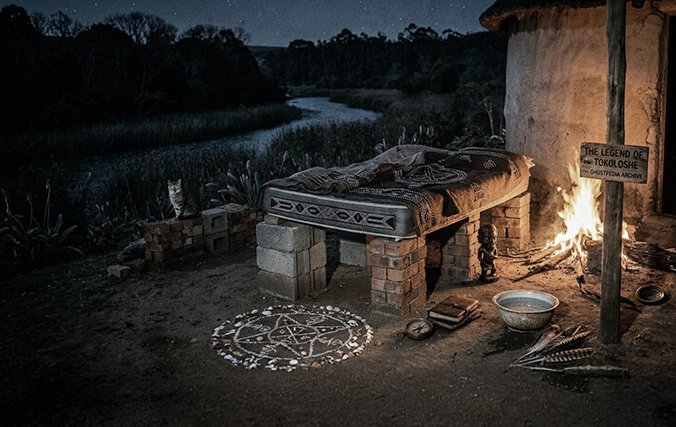
The Raised Threshold: Tokoloshe Lore
Set along the quiet riverbanks of Southern Africa, this scene from the Ghostpedia Archive captures a traditional night setup designed around Zulu and Xhosa folklore: a bed elevated on cinder blocks and bricks—a widespread folk precaution meant to keep a sleeping person safely out of reach from the short, wandering Tokoloshe spirit. Under a clear, starlit night sky, a protective chalk sigil rings the earth beside a bowl of water and ritual feathers, while a crackling hearthfire casts a warm, golden glow against the thatched hut and a watchful cat sits vigil near the shore. Beyond the physical safeguards crafted to ward off disruption, the elevated hearth serves as a evocative symbol—a reminder of the timeless human effort to establish sacred boundaries, intentionality, and inner peace during the quietest hours of the night.