


Entity Profile:
The Monk of Cong Abbey (Brother Malachy)
Entity Classification: Early 13th-Century Benedictine Revenant, Floating Threshold Guardian & Unforgiving Creative Auditor
Origin: The Rain-Swept Peat Bogs, Limestone Fissures, and Roaring Waters of Cong Abbey, County Mayo, Ireland (Circa 1205 CE)
Adoption Status: Available for Immediate Sanctuary (Provided you can withstand the silent, hovering judgment of a medieval scribe who died of pure, unadulterated perfectionism)
The Legend & Lore:
A Masterclass in Scribe Madness and Structural Terror
Before modern culture reduced horror to cheap jump-scares, flickering hallway lights, and predictable ghost stories, the jagged limestone fissures and mist-choked peat bogs of western Ireland forged something infinitely more psychological: The Monk of Cong Abbey.
Deep within the crumbling, rain-lashed ruins of Cong Abbey—founded in the early 12th century and celebrated across medieval Europe as a sanctuary of scholarly illumination—history was written not just with ink, but with agonizing, obsessive devotion. Yet beneath the abbey's pious exterior, the crushing weight of isolation and religious fanaticism frequently pushed its scribes past the absolute breaking point.
Enter Brother Malachy, a brilliant, obsessive, and profoundly unhinged Benedictine monk tasked in the early 13th century with illuminating the monastery's final, most sacred manuscripts. Seeking total isolation, Malachy locked himself inside the claustrophobic stone Fishing House—a chilling architectural marvel suspended directly over the roaring, churning, pitch-black currents of the Cong River.
Day and night, the deafening roar of the river battered his sanity. Combined with severe sleep deprivation and self-imposed starvation, Malachy became utterly possessed by the geometric alignment of letters and layout composition. He convinced himself with terrifying certainty that a single misplaced ink stroke could rip open a permanent portal straight to purgatory. As he wasted away to a skeletal frame, his mind completely fractured—reaching its fever pitch precisely as soldiers breached the abbey's walls, leaving Malachy to perish alone over his final, blood-spattered parchment.
For centuries, local folklore has warned of what happens when the midnight mist rolls off the river bogs. Unlike ordinary phantoms that shuffle or drag their feet, The Levitating Monk glides. Shrouded in a rotting, mud-caked wool cowl that perpetually drips with freezing river water, he hovers silently just above the floorboards. When he drifts through a room, lifting his hood reveals no human face at all—only two hollow, bottomless eye sockets anchored by a jagged, bone-white skeletal grin frozen in eternal mockery.
Unbeatable Perks of Bringing
The Monk Into Your Sanctuary
Zero Ghostly Theatrics, 100% Gravity: Forget neurotic poltergeists who throw fine china or leave mysterious cold spots. The Levitating Monk operates with the minimalist, terrifying discipline of a medieval scriptorium. He doesn't float around making noise; he hovers silently behind your workspace, bringing instant, museum-grade historical weight and profound atmospheric gravity to any study, library, or office.
Certified 800-Year-Old Architectural Focus: This entity literally starved himself over sacred geometry and manuscript layouts until his mind snapped under the pressure of absolute standards. Placing him in your workspace isn't just an aesthetic upgrade—it’s the supernatural equivalent of fortifying your room with thirteenth-century monastic stone ramparts. Distractions, sloppy habits, and half-baked ideas simply bounce off his aura.
The Ultimate Antidote to Mediocrity: Featuring that iconic, hovering, mud-soaked wool cowl and a frozen skeletal grin, the Monk is the supreme silent companion for anyone tired of watering down their ambitions. He will never validate your procrastination, nor will he nod politely at a compromised, rushed project. He hovers quietly in the peripheral shadows, reminding you that true craft requires absolute focus and uncompromising execution.
Unmatched Conversational Presence: Invite friends, colleagues, or curious guests into a room guarded by the Monk, and watch the conversational temperature drop ten degrees. Prepare for lowered voices, sharp observations, and the inevitable, reverent question: "Where on earth did you uncover this?"
Real Reviews from Sanctuary Hosts!
"Completely cured my creative procrastination."
"I spent weeks agonizing over whether a project was 'good enough' to ship. The night I installed the Monk in my studio, the room smelled faintly of wet river-moss and old vellum, and I suddenly realized nobody ever built a legacy out of 'good enough.' Best decision I've made all year."
— R. M., Editorial Designer & Author
"Heavy, silent, and wonderfully intimidating."
"Most spooky decor looks like it came out of a seasonal shop. The Monk feels like an artifact pried straight out of an 800-year-old Irish river vault. Even my clients stand in front of his corner in total, respectful silence."
— C. D., Creative Director
"He keeps me honest when I’m burning the midnight oil."
"There is nothing quite like glancing up from a half-hearted draft late at night and catching that hovering cowl and bone-white grin staring from the shadows. You immediately sit up straighter and do the real work. 10/10 would let him audit my life choices again."
— A. L., Insomniac & Writer
Field Notes:
The Audit of the Scriptorium
When the temperature in your room plummets without a draft, and the heavy, decaying scent of dead river-moss, damp wool, and ancient iron-gall ink overtakes the air, do not bother checking the window.
He has already materialized in the freezing shadows right behind your chair.
The Monk does not materialize to rattle chains or deliver melodramatic prophecies. Having sacrificed his sanity to the merciless geometry of the thirteenth century, he possesses the crushing, unsentimental perspective of a scholar who knows exactly how brief human time really is. He hovers an inch above the floor, his rotting wool cowl tilted at a critical angle, inspecting your work with the cold, unblinking gaze of a man who literally died for absolute perfection.
He isn't looking for a fight; he is looking for proof of discipline. He weighs the sincerity of your focus, the structural honesty of your labor, and the courage of your output against the unyielding standards of Cong Abbey. One long, skeletal finger taps against the edge of your desk—a dry, echoing tick that sounds like a quill striking vellum—reminding you in absolute silence that you are spending finite, irreplaceable hours on earth.
And when he finally drifts back into the gloom, leaving behind the faint, damp scent of a Mayo river current, you are left with one undeniable mandate: make every single mark count before you join the dirt.
A tale on the Monk of Cong Abbey
The Last Page at the Weir
The rain in County Mayo does not fall so much as it occupies the atmosphere, a gray, microscopic needle-mist that turns the limestone flagstones of Cong into slick slabs of green-veined tallow.
Damián had not wiped his boots. He had left them on the braided jute rug in the rented cottage outside Cross, leaving two muddy smears shaped like question marks. He sat on the edge of the iron bedstead, his sneakers unlaced, rolling a blue plastic token between his thumb and forefinger—a little top-hat he had pocketed from a board game four years ago during a rainy Sunday afternoon in Madrid, back when the future still felt like something that could be negotiated with a roll of the dice.
"It’s just an old stone house, Sofía," he said, not looking up from the token. "The damp gives it character. Better than your father’s clinic in Dublin smelling of carbolic acid and starch."
Sofía stood by the narrow, deep-set window, her coat still buttoned to the chin. Outside, through the dripping leaded panes, the ruins of the Augustinian abbey loomed against the twilight like broken teeth stuck in the sod. Below them, hidden by the elderberry thickets, the Cong River raced toward Lough Corrib with the low, monotonous roar of an engine that had lost its governor.
"My father is a surgeon, Damián," she said, her voice small and cold in the unheated room. "He spends twelve hours a day fixing things that are broken. He didn't spend twenty years paying for my term at Cambridge so I could spend my twenties eating tinned mackerel in a wet sheep-pen with a man who hasn't opened a textbook since the administration of Rajoy."
"I have my plans," Damián muttered, though the top-hat felt very small and very light between his fingers. "We’ll cross to Galway. We’ll find a flat near the docks. We’ll figure it out."
"With what?" Sofía turned from the glass, her dark eyes looking too large in a face that had grown thin over the last three weeks of damp roads, petrol stations, and stale ham sandwiches. "Your mother’s pension? Or those Tuesday nights with your old schoolmates on WhatsApp while you buy virtual hotels on a screen?"
She didn't wait for an answer. She reached for her rucksack on the floor, her fingers stiff with the chill that seemed to rise straight out of the mortar between the stones.
They had crossed the border three days before, running from a family council that had ended with her father’s voice shaking behind the frosted glass of the consulting room—she is throwing her life into a ditch with a boy who has no more shape than water—and here they were, six hundred miles from home, trapped in a room that smelled of old sheep-fat and rotting peat, waiting for a marriage that felt less like a beginning and more like a mutual surrender.
At eleven o'clock, the paraffin heater died with a small, wet cough.
The temperature in the room didn't drop gradually; it fell off a cliff. The smell of wet wool and tallow was instantly obliterated by a heavy, ancient stench—the unmistakable odor of dead river-moss, damp vellum, and the sharp, metallic tang of iron-gall ink that had dried in a scriptorium eight centuries ago.
Damián stopped rolling the plastic top-hat.
"Did you leave the cellar door open?" he asked, his skin tightening over his collarbones. "There’s a draught like a tomb."
Sofía didn't answer. She was staring at the heavy oak door that led to the corridor.
The floorboards did not creak. There was no sound of boot-leather, no heavy footfall of a landlord or a late-night traveler seeking shelter from the Mayo mist. Instead, there was a low, dry scratch-tick, like a quill nib moving across parchment with frantic, mechanical speed.
Tick. Tick. Tick.
Then came the cold. Not the crisp, clean cold of a winter frost, but a heavy, stagnant grease that coated the inside of the lungs and made every breath taste of river silt.
Damián stood up, his mouth half-open to make some small, defensive joke about the local B&B trade, when the door didn't open—it simply ceased to matter that it was closed.
The figure that drifted across the threshold was not tall, but it possessed an absolute, light-absorbing density that made the corner of the room go entirely black. It was shrouded in a heavy wool cowl so soaked with river water that the fabric hung in stiff, calcified folds, dripping a dark, slow liquid onto the floorboards.
It hovered three inches above the pine boards. When it moved, it didn't walk; it glided with the dreadful, silent momentum of a raft caught in a subterranean weir.
Sofía pressed her back against the window frame, her hand flying to her mouth, though no sound came out. Her medical textbooks, her anatomical charts, her years of clinical detachment—all of it dissolved in an instant before the sheer, unearthly weight of the thing standing by the washstand.
The monk raised his head.
Where a face should have been beneath the rotting cowl, there was only a vertical void—two hollow, bottomless sockets that didn't look at them so much as they weighed them, measuring their density, their history, and their excuses against a standard so high it made the air ache. Below the sockets was a mouth carved entirely out of bone—a jagged, ivory-white grin frozen in an eternal, terrifying mockery of human peace.
"Damián,"
The name didn't come through the air. It scraped directly against the enamel of their teeth, dry and clinical like a fingernail dragged across a slate tombstone in the rain.
Damián tried to step backward, but his heel caught on the edge of the jute rug. He fell half-awkwardly onto the iron bed frame, the metal groaning under his weight.
The Levitating Monk drifted closer. He stopped beside the small deal table where Damián had left his plastic top-hat and a half-eaten packet of biscuits. One long, gray hand—tipped with fingers like charred willow-twigs—reached out from beneath the sodden wool.
It didn't touch Damián. It touched the little plastic token.
Clack.
The sound was small, but it echoed in the tiny room like a hammer hitting an anvil in a cave.
"Fourteen years," the voice grated inside their skulls, smelling of old vellum and stagnant water. "Fourteen years of rolling the dice, Damián. Fourteen years of moving little green houses across a board while the real world rotted around your ankles. You ran away to Ireland because you thought distance would give your life a plot. You thought a girl with a brilliant future would pull you along like a barge on a tow-line."
Sofía’s breath hitched. She looked at Damián—really looked at him—for the first time since they had crossed the Pyrenees. She saw the soft jaw, the dull, panicked eyes, the total absence of anything to hold onto when the wind blew.
"He didn't come here to build a life," the monk whispered, his skeletal grin widening as the dark water dripped faster from his cowl, forming a small, black pool on the floorboards. "He came here to hide from the fact that he has nothing to say. He is a blank page that smells of stale tobacco and small ambitions."
"Get out," Damián croaked, his hands clawing at the iron mattress frame. "What do you want? We're tourists. We're leaving tomorrow."
The monk turned his hollow sockets toward Sofía.
For a second, the pressure in the room lifted just enough for her to draw a ragged breath. The entity didn't judge her for running; he judged her for settling. He saw the three years of late-night labs, the scalpels, the slides of human tissue, the desperate desire to heal—all being bartered away for the cozy, miserable comfort of a man who wanted to play board games while the world went by.
"And you, Sofía," the monk hissed, the dry rustle of his wool habit sounding like dead leaves in a drought. "You spent twenty-one years learning how to save a life, and now you’re willing to spend the next fifty watching his drain away into the carpet. Is this the diagnosis you studied for?"
The entity raised both hands. The long, skeletal fingers hovered an inch above the table, trembling with an intensity that felt like a high-voltage current.
With one slow, deliberate motion, the monk swept his hand across the deal table.
The plastic top-hat, the biscuit crumbs, the spare change, and the map of Mayo didn't scatter—they vanished into the dark puddle of river water on the floor, dissolving as if they had never existed at all.
"There is no board left, Damián," the monk whispered, leaning down until the reek of the Cong River filled their throats with the taste of cold mud and ancient lime. "There are only the hours you spent, and the hours you threw away. When the morning comes over the weir, the ink will be dry."
A violent gust of wind tore through the window—not breaking the glass, but passing right through it like breath through a screen—carrying the smell of wet grass, peat smoke, and the vast, cold expanse of Lough Corrib.
Then, with the sudden, sharp snap of a dry twig, the room was silent.
The gray Mayo light was already pooling on the linoleum when Sofía opened her eyes.
The paraffin heater was cold. The mud on the jute rug had dried into a pale, gray crust. The room smelled of nothing more threatening than damp air and wool.
Damián was sitting on the edge of the bed, staring at his hands. He hadn't unlaced his left shoe. His fingers were twitching against his knees, opening and closing as if they were trying to grip something that wasn't there anymore.
"Damián," she said. Her voice was quiet, but it didn't shake.
"We need to go back," he whispered, his eyes fixed on the empty space on the table where the plastic top-hat had been. "The ferry. We can catch the evening sailing from Dublin."
Sofía stood up. She walked over to the window and pushed it wide open. The roar of the Cong River came up to them through the wet morning—steady, heavy, and indifferent, tearing its way through the limestone toward the sea.
"No," she said, picking up her rucksack and swinging it over one shoulder. "You can take the bus to Dublin, Damián. I’m taking the train to Cork."
She didn't look back to see if he was following. The room behind her was very quiet, and on the clean, empty table by the window, the dust had settled into a shape that looked very much like a page waiting for a pen.
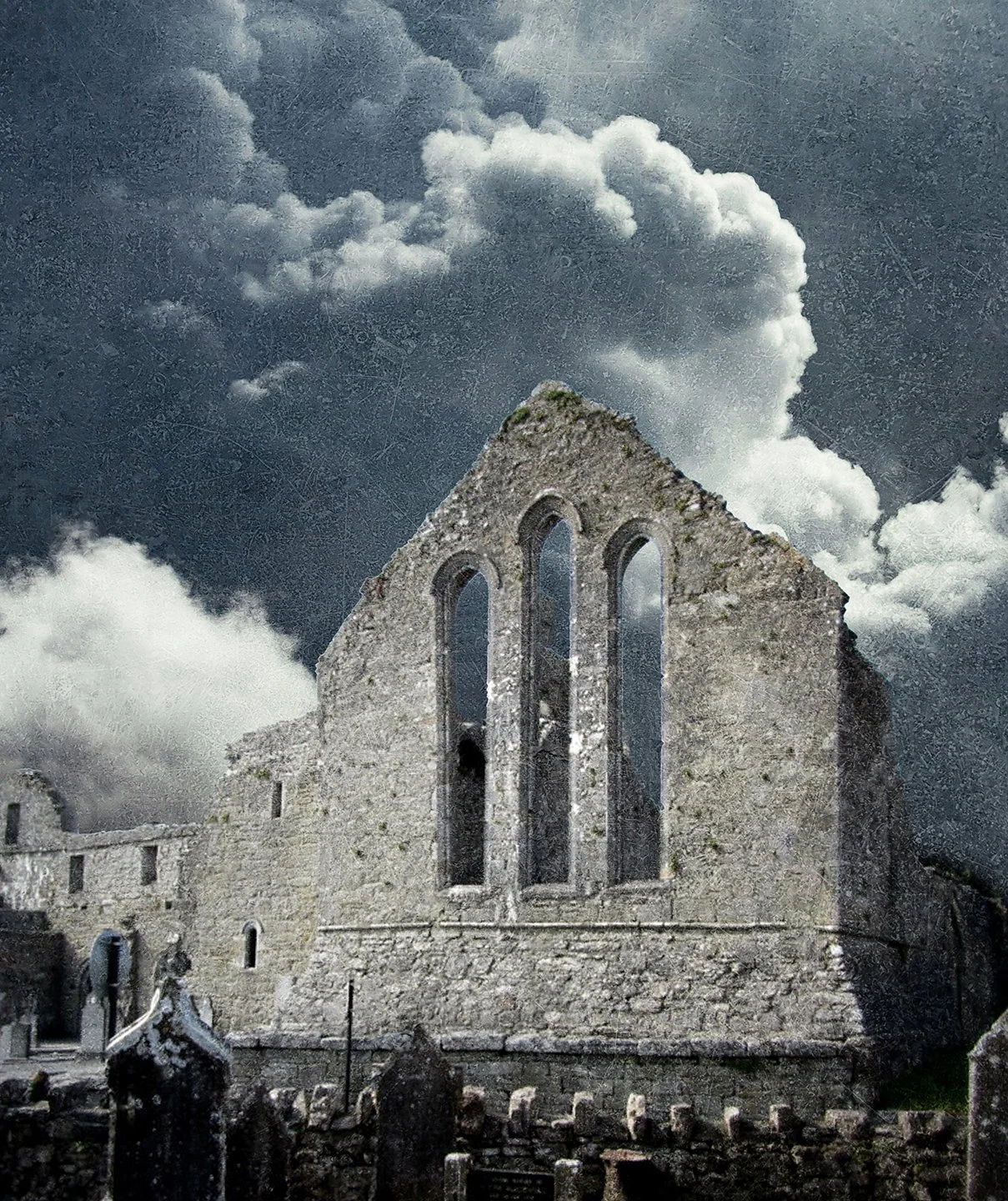
Cong Abbey
Under a brooding sky that holds centuries of secrets, the fractured arches of Cong Abbey stand silent. Yet, many believe the silence is broken by the soft glide of sandaled feet. When the wind howls through these ruins, it is said to bear the whispered chants of THE MONK, still keeping vigil over his lost sanctuary.